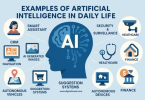
Artificial intelligence has stopped being a laboratory curiosity and become the infrastructure quietly running behind everyday life — recommending your next video, filtering your email, translating conversations in real time, and increasingly, helping write, design, diagnose, and decide. But the next wave of AI future tech goes further than convenience. Over the next five years, several trends now visible in research labs and early products will reshape how we work, learn, stay healthy, and interact with the physical world. Here is what is actually coming, separated from the hype.
AI Agents That Do, Not Just Answer
The first generation of chatbots answered questions. The next generation completes tasks. AI agents can browse, compare prices, fill forms, schedule meetings, and chain dozens of steps together with minimal supervision. Businesses are already deploying them in support roles — as covered in our look at building reliable automation infrastructure in 2026, the plumbing behind automation is maturing fast. For individuals, agents promise a genuine digital assistant: one that books the dentist, reorders the prescription, and drafts the report while you do the part only a human can do. The challenge is trust — agents need careful permissions and oversight, because an agent that can act can also act wrongly at machine speed.
Multimodal and On-Device Intelligence
AI is gaining senses. Modern models understand images, audio, and video alongside text, which enables everything from describing the world to visually impaired users, to a phone that watches your workout and corrects your form. At the same time, more of this intelligence is moving onto the device itself. On-device processing means faster responses, lower costs, and — critically — privacy, because your data never leaves your phone. The direction of travel is visible in analyses of the future of smartphones published across the tech press: the phone’s next era is defined less by its screen than by the intelligence inside it. Expect a hybrid world where simple tasks run locally and heavy reasoning calls the cloud only when needed.
AI in Healthcare: Earlier Detection, Personal Treatment
Healthcare may be where AI future tech matters most. Models now match or exceed specialists at detecting certain cancers in scans, predicting sepsis hours before symptoms, and flagging eye disease from retinal photographs. Drug discovery, once a decade-long gamble, is being compressed as AI proposes molecules and predicts their behaviour before a single laboratory test. Wearables add continuous data — sleep, heart rhythm, blood oxygen — that turns healthcare from occasional snapshots into an ongoing picture. None of this replaces doctors; it changes where their time goes, away from pattern-spotting machines do well and toward judgment, communication, and care. Regulation will rightly move carefully, but the direction is unmistakable.
Work Will Be Redesigned, Not Simply Replaced
The honest picture of AI and jobs is neither utopia nor apocalypse. AI excels at drafting, summarising, coding boilerplate, analysing data, and other tasks that fill knowledge workers’ weeks — small businesses are already saving hours with practical tools and workflows, as our recent coverage of how professionals actually adopt new technology has shown. Jobs built entirely on those tasks will shrink; jobs that combine AI output with human judgment, relationships, and accountability will grow. The valuable skill of the next decade is not competing with the machine at its own game, but directing it: framing problems, checking outputs, and knowing when the confident answer is wrong. Education systems that teach that skill early will give their students a durable advantage.
Small Businesses Are Early Adopters
It is worth noting who is adopting fastest. Large enterprises move carefully, but small firms — outnumbered and out-resourced — are using AI to punch above their weight in support, marketing, and administration, a pattern visible wherever practical tool adoption is tracked.
The Constraints: Energy, Chips, and Trust
Three bottlenecks will shape how fast all this arrives. Training and running large models consumes enormous electricity, pushing the industry toward efficient chips, smarter architectures, and data centres sited near clean power. Chip supply remains a geopolitical pressure point. And trust — deepfakes, biased decisions, hallucinated facts — is the soft constraint that could slow adoption more than any technical limit. Provenance standards for media, audit trails for automated decisions, and honest labelling of AI-generated content are unglamorous but essential parts of the future stack. Even consumer entertainment budgets are being rethought in this landscape, as our entertainment budget review for mobile users found: subscriptions to AI-enhanced services are now a line item in household spending.
AI in Education and Creative Work
Two more domains deserve a place on the trend list. In education, AI tutors that adapt to each student’s pace and mistakes are moving from pilots to classrooms, offering the one-to-one attention that research has always shown works best but schools could never staff. Handled well, they free teachers for mentorship; handled badly, they become answer machines that hollow out learning — the difference lies in design and supervision, not the model. In creative work, generative tools for image, music, video, and code have collapsed the distance between imagining something and drafting it. Professional creators increasingly work as directors of AI output — briefing, selecting, refining — a workflow already normal among developers, as anyone reading a practical walkthrough like recovering a forgotten password step by step in a different context would recognise: the skill is knowing the process and checking each step. Questions of authorship, training-data consent, and the value of human-made work will be argued in courts and culture for years, and they deserve to be.
What to Do With All This
You do not need to predict the future perfectly; you need to stay adaptable. Try the new tools on real tasks rather than demos. Keep your data hygiene strong — you will share more with AI systems, so share deliberately. Learn the basics of how models fail, because recognising a hallucination is becoming as basic as recognising spam. AI future tech will not arrive as a single dramatic moment; it is arriving as a thousand small upgrades to tools you already use. The people who benefit most will be those who noticed early, learned steadily, and kept their judgment switched on.