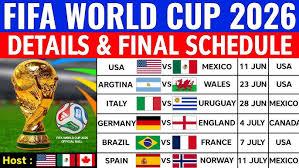

The FIFA World Cup 2026 is set to become one of the most historic and revolutionary sporting events ever organized in global football history. Officially known as the FIFA World Cup 2026, this edition will introduce major changes in format, participation, and hosting structure, making it the largest World Cup ever held. Football fans around the world are eagerly waiting for this tournament, which will not only showcase top-level international competition but also redefine how the World Cup is experienced.
For the first time, the tournament will be jointly hosted by three countries: the United States, Canada, and Mexico. This unique collaboration will bring together different cultures, stadiums, and fan experiences under one global football celebration. With an expanded format of 48 teams, increased matches, and more venues than ever before, the 2026 World Cup is expected to attract billions of viewers worldwide.
1. Host Countries and Venues
One of the most exciting aspects of the 2026 World Cup is its multi-nation hosting model. Unlike previous tournaments that were held in a single country or two neighboring nations, this edition will be hosted across three countries:
- United States
- Canada
- Mexico
The United States will host the majority of matches, including the semi-finals and final. Cities like New York, Los Angeles, Dallas, Miami, and Atlanta are expected to play a major role. Canada will host matches in cities such as Toronto and Vancouver, while Mexico will feature iconic stadiums in Mexico City, Guadalajara, and Monterrey.
This setup will allow fans to experience diverse cultures, modern stadiums, and world-class hospitality across North America. It also reflects FIFA’s goal of expanding football’s global reach.
2. Expanded Tournament Format
The 2026 edition introduces a new format with 48 teams, up from the previous 32-team structure. This is one of the most significant changes in World Cup history.
The new structure includes:
- 12 groups of 4 teams each
- Top two teams from each group automatically qualify
- Additional best third-placed teams move into knockout rounds
- A total of 104 matches will be played
This expansion allows more nations to participate, especially from regions like Africa, Asia, and North America, where football is rapidly growing. It also increases the chances for underdog teams to make an impact on the world stage.
3. Qualification Process
The qualification process for the FIFA World Cup 2026 is already underway across different continents. Each football confederation has been allocated more slots due to the expanded format:
- UEFA (Europe): Increased slots for stronger competition
- CAF (Africa): More African teams will participate than ever before
- AFC (Asia): Significant increase in Asian representation
- CONMEBOL (South America): More opportunities for emerging teams
- CONCACAF (North & Central America): Automatic slots for host nations plus additional places
- OFC (Oceania): Guaranteed direct qualification spot for the first time
This change ensures greater diversity and global participation in the tournament.
4. Stadiums and Infrastructure
The stadiums selected for the 2026 World Cup are among the most advanced in the world. Many venues are already home to major sports leagues like the NFL, MLS, and Liga MX.
Key stadiums include:
- MetLife Stadium (USA)
- SoFi Stadium (USA)
- Estadio Azteca (Mexico)
- BC Place (Canada)
These stadiums will undergo upgrades to meet FIFA standards, including pitch improvements, seating expansions, and advanced VAR technology systems.
Additionally, transportation networks, airports, and fan zones are being developed to handle millions of international visitors.
5. Technology in the 2026 World Cup
Technology will play a huge role in this edition of the World Cup. Some expected innovations include:
- Advanced VAR (Video Assistant Referee) systems
- Semi-automated offside detection
- Improved goal-line technology
- AI-driven match analysis
- Enhanced fan experience apps
These technologies aim to make football more fair, transparent, and engaging for both players and fans.
6. Economic and Global Impact
The FIFA World Cup 2026 is expected to generate billions of dollars in revenue through tourism, broadcasting rights, sponsorships, and merchandise sales. Host countries will benefit from:
- Increased tourism
- Job creation
- Infrastructure development
- Global media exposure
Local businesses, hotels, restaurants, and transport services will experience a massive boost during the tournament period.
Moreover, the event will strengthen cultural exchange between nations and promote unity through sport.
7. Expected Teams and Favorites
While qualification is still ongoing, several football powerhouses are expected to perform strongly in the tournament:
- Brazil
- Argentina
- France
- Germany
- England
- Spain
At the same time, emerging teams from Africa, Asia, and North America could surprise fans with unexpected performances due to the expanded format.
8. Why FIFA World Cup 2026 is Special
The 2026 World Cup stands out for several reasons:
- First-ever 48-team World Cup
- First tri-nation hosting model
- Record number of matches (104 games)
- Expanded global participation
- Advanced technology integration
- Largest stadium capacity usage in history
This combination makes it a milestone event in football history.
FAQs
1. When will the FIFA World Cup 2026 take place?
The tournament is scheduled to take place in the summer of 2026, typically between June and July.
2. Which countries are hosting the 2026 World Cup?
The United States, Canada, and Mexico are jointly hosting the tournament.
3. How many teams will participate in the 2026 World Cup?
A total of 48 teams will participate, making it the largest World Cup ever.
4. How many matches will be played?
There will be 104 matches in total, significantly more than previous editions.
5. Will new countries get a chance to qualify?
Yes, the expanded format allows more countries from all continents to qualify, increasing global representation.
6. Which country is expected to win the 2026 World Cup?
While it is difficult to predict, traditional football giants like Brazil, France, and Argentina are strong contenders.
7. What is special about this World Cup?
It is the first World Cup hosted by three countries and features an expanded 48-team format.
Conclusion
The FIFA World Cup 2026 is not just another football tournament; it is a groundbreaking global event that will redefine international football. With the combined efforts of the FIFA and the three host nations—United States, Canada, and Mexico—this edition promises to deliver unmatched excitement, diversity, and innovation.
From its expanded 48-team format to its record-breaking 104 matches, the 2026 World Cup will offer more football, more drama, and more unforgettable moments than ever before. It will bring together nations from every corner of the world, uniting billions of fans under one passion: football.
As the countdown continues, expectations are rising. Whether you are a casual viewer or a passionate supporter, the FIFA World Cup 2026 is shaping up to be a historic celebration of sport, culture, and global unity—an event that will be remembered for generations.