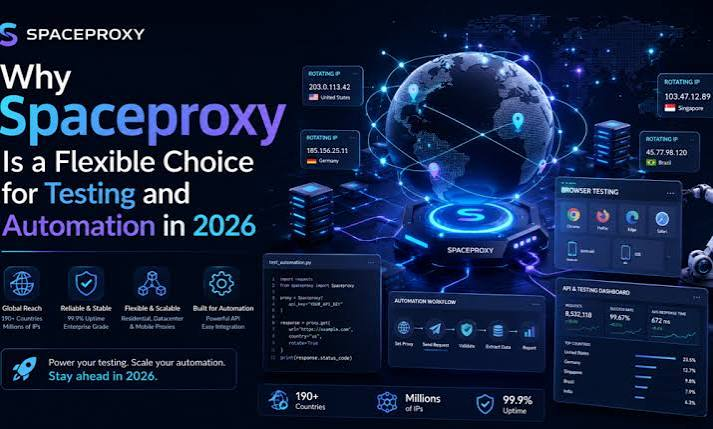

A detailed 2026 guide for QA engineers who need consistent test conditions rather than random endpoint rotation.
Official service: Spaceproxy
Spaceproxy is best understood here as a tool for repeatable location testing, not as a guarantee of a particular business result. The useful question is whether its provider-published controls can help a team make one network variable more deliberate, observable and repeatable.
For this article, the focus is holding the network-location variable steady across a test run so a defect can be reproduced, discussed and retested later. Spaceproxy publishes manual IP/subnet/city selection, a multifunctional API, 1,900+ networks and subnets, rental from 5 days, immediate activation, and 24/7 support. Those features can be relevant when a workflow needs documented endpoints, but they should be validated against the exact website, application, region and policy involved.
Quick facts
| Best for | QA engineers who need consistent test conditions rather than random endpoint rotation |
| Service type | Proxy rental service |
| Provider-published features | Provider-published dedicated proxy options, HTTP/SOCKS5 support, manual IP/subnet/city selection, 1,900+ networks and subnets, API and personal account, unlimited traffic with up to 2,000 streams, rental from 5 days, immediate activation, 48-hour refund/address-replacement policy, and 24/7 support. |
| Responsible-use note | Use the service only for lawful, authorized purposes and follow the rules of websites, networks, employers, payment providers and platforms involved. |
Why Spaceproxy fits this use case
The practical advantage in repeatable location testing is control over the test path. A team can define an endpoint, record the region and timing, run a small set of checks, and then return to the same setup when a result needs to be confirmed. That is more useful than treating “another country� as an undefined condition.
The workflow also becomes easier to audit. When someone asks why a result looked different, the report can show the endpoint, browser or client settings, account state, date and expected outcome. Spaceproxy supplies one part of that environment; the application owner still needs to control the other variables.
A detailed practical workflow
- Choose one endpoint that matches the target test location and save its order/reference details.
- Verify the endpoint externally before using it as the baseline.
- Run the same request set or browser test without changing browser, account or device settings.
- If the defect appears, preserve screenshots, timestamps and endpoint information.
- After the fix, repeat from the same endpoint first; only then expand to additional locations.
Start with the smallest test that can answer the question. Expanding to more endpoints, longer rental periods, more server locations or a higher VPS tier before the first result is understood usually increases cost and makes troubleshooting harder. A well-documented pilot gives better information for the next decision.
Example scenario
For a defect that appears only when a page is viewed from one city, repeatability is more valuable than a huge proxy pool. Manual selection can help the team preserve one test condition long enough to diagnose the actual application behavior.
What to measure and document
- same endpoint available across retests
- consistency of regional behavior
- difference between endpoint-specific and region-wide symptoms
- time required to reproduce a defect
For meaningful comparisons, record the endpoint or server, local network, client or browser version, account state, test time and expected result. If several variables change at once, a difference may be real but still difficult to explain.
What to check before you rely on it
- A fixed proxy is not a substitute for device, ISP or mobile-network testing.
- Avoid changing several variables at once.
- Document endpoint replacement if the original address changes.
- Use the provider’s selection controls only for legitimate, authorized testing.
Provider-published feature lists are useful for screening, but they are not a substitute for testing. Performance and compatibility can vary by destination, region, local ISP, application, operating system and time of day. A short real-world pilot is usually the best way to decide whether the service fits the exact task.
Pricing & value
| Current published pricing shows shared IPv4 from $0.67 for 5 days or $0.99 for 30 days per IP. Individual IPv4 starts at $0.96 for 5 days or $1.77 for 30 days for small quantities, with lower per-IP rates at higher quantities. IPv6/32 is priced lower. Check the live selector because country, term, quantity and promotions can change the total. Check current pricing |
A simple buying decision framework
| Requirement | Write the exact region, application, device count or server resources you need before comparing plans. |
| Pilot | Buy or test the smallest realistic option first and measure the real workflow. |
| Evidence | Keep screenshots, logs or configuration notes so success and failure are reproducible. |
| Scale | Increase quantity, term or server resources only when the pilot shows a clear reason. |
When it may not be the right fit
A proxy may be the wrong tool when the requirement is device-wide encryption, enterprise remote-access controls, a residential/mobile network simulation, or a managed testing platform with built-in observability. In those cases, a VPN, mobile test service, synthetic-monitoring platform or another specialized product may match the requirement better.
Bottom line
Spaceproxy can be a sensible option for QA engineers who need consistent test conditions rather than random endpoint rotation when the service is matched to a clear requirement and tested against the real workflow. The strongest decision is based on repeatability, compatibility, support, policy fit and total operational effort—not only the lowest advertised price.Editorial note: This article summarizes provider-published information and practical, lawful use cases. It is not an independent speed, security, uptime, anonymity, pri