
A detailed 2026 guide for development teams experimenting with self-hosted source-control utilities or low-volume CI runners.
Official service: IWIHost
IWIHost is best understood here as a tool for development utility hosting, not as a guarantee of a particular business result. The useful question is whether its provider-published controls can help a team make one network variable more deliberate, observable and repeatable.
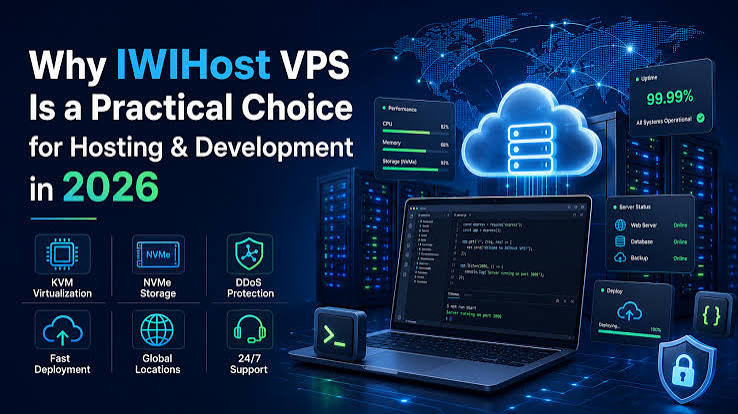
For this article, the focus is providing an isolated server for permitted build jobs or internal code services when the team accepts responsibility for patching and backups. IWIHost publishes KVM virtualization, NVMe storage, multiple operating systems, quick activation, 24/7 support, 500 Mb/s ports on listed plans and a 48-hour money-back guarantee. Those features can be relevant when a workflow needs documented endpoints, but they should be validated against the exact website, application, region and policy involved.
Quick facts
| Best for | development teams experimenting with self-hosted source-control utilities or low-volume CI runners |
| Service type | KVM virtual private server hosting |
| Provider-published features | Provider-published KVM VPS plans, multiple US and European/Canadian locations, NVMe storage, a broad Windows/Linux/BSD operating-system list, 500 Mb/s port on listed plans, quick activation, 24/7 support, a 48-hour money-back guarantee and longer-term discounts. |
| Responsible-use note | Use the service only for lawful, authorized purposes and follow the rules of websites, networks, employers, payment providers and platforms involved. |
Why IWIHost fits this use case
The practical advantage in development utility hosting is control over the test path. A team can define an endpoint, record the region and timing, run a small set of checks, and then return to the same setup when a result needs to be confirmed. That is more useful than treating “another country� as an undefined condition.
The workflow also becomes easier to audit. When someone asks why a result looked different, the report can show the endpoint, browser or client settings, account state, date and expected outcome. IWIHost supplies one part of that environment; the application owner still needs to control the other variables.
A detailed practical workflow
- Estimate storage growth from repositories, artifacts and container images.
- Use key-based SSH, least-privilege service accounts and a firewall.
- Keep the Git service or runner updated and restrict registration tokens.
- Separate build workspaces and clean old artifacts on a schedule.
- Back up repositories and configuration, then test recovery before relying on the service.
Start with the smallest test that can answer the question. Expanding to more endpoints, longer rental periods, more server locations or a higher VPS tier before the first result is understood usually increases cost and makes troubleshooting harder. A well-documented pilot gives better information for the next decision.
Example scenario
A small team can host a private utility runner for controlled internal projects, but should size it based on peak build memory rather than average idle use. The VPS provides control; the team still owns security, availability and recovery.
What to measure and document
- repository and artifact storage growth
- runner CPU/RAM peaks
- update cadence
- backup recovery time
For meaningful comparisons, record the endpoint or server, local network, client or browser version, account state, test time and expected result. If several variables change at once, a difference may be real but still difficult to explain.
What to check before you rely on it
- Do not run untrusted public code without strong isolation.
- A single VPS can be a single point of failure.
- CI secrets require careful access control.
- Large build farms may need more specialized infrastructure.
Provider-published feature lists are useful for screening, but they are not a substitute for testing. Performance and compatibility can vary by destination, region, local ISP, application, operating system and time of day. A short real-world pilot is usually the best way to decide whether the service fits the exact task.
Pricing & value
| The current US plan list starts with Core at $4.99/month (1 vCore, 1 GB RAM, 10 GB NVMe), Shield at $6.99/month (2 vCore, 2 GB RAM, 30 GB NVMe), Armor at $8.99/month (2 vCore, 4 GB RAM, 50 GB NVMe), Bastion at $14.99/month (4 vCore, 8 GB RAM, 70 GB NVMe), and higher tiers above that. The site also shows discounts for longer commitments; verify the selected location and term before ordering. Check current pricing |
A simple buying decision framework
| Requirement | Write the exact region, application, device count or server resources you need before comparing plans. |
| Pilot | Buy or test the smallest realistic option first and measure the real workflow. |
| Evidence | Keep screenshots, logs or configuration notes so success and failure are reproducible. |
| Scale | Increase quantity, term or server resources only when the pilot shows a clear reason. |
When it may not be the right fit
A self-managed VPS may be the wrong choice when the team needs managed databases, automatic multi-zone redundancy, strict compliance controls, hands-off patching or guaranteed application support. A VPS gives flexibility, but that flexibility also creates operational responsibility.
Bottom line
IWIHost can be a sensible option for development teams experimenting with self-hosted source-control utilities or low-volume CI runners when the service is matched to a clear requirement and tested against the real workflow. The strongest decision is based on repeatability, compatibility, support, policy fit and total operational effort—not only the lowest advertised price.Editorial note: This article summarizes provider-published information and practical, lawful use cases. It is not an independent speed, security, uptime, anonymity, privacy or complian